Why won't MPs tax the rich? We asked them – and their answers gave us hope
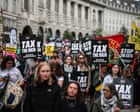
Yet the first budget of the Burnham era looks set to dodge the issue In John Healey’s first budget this week, we will finally get a sense of the economic policies that will deliver Andy Burnham’s pledge to end neoliberalism. Faiza Shaheen is executive director of Tax Justice UK Continue reading...
Even most Reform voters are in favour of a tax on the super-wealthy. Yet the first budget of the Burnham era looks set to dodge the issue
In John Healey’s first budget this week, we will finally get a sense of the economic policies that will deliver Andy Burnham’s pledge to end neoliberalism. Or will we? Capital gains tax equalised with income tax? Ruled out. A genuine wealth tax on those sitting on over £10m? Off the table. Even the briefed increase in the banking surcharge only takes us back to where it was until the Conservatives cut it in 2023. We can cross our fingers for trailed policies on supporting high streets, financial devolution and longer-term investment, but there is still more than a whiff of trickle-down economics in the air.
Poll after poll shows that the British public overwhelmingly supports wealth taxes on the super-rich – including three in five Reform-leaning voters. We know that wealth inequality – with the richest 50 families in the UK possessing more wealth than half of the UK population – is weakening our economy, eroding our social fabric and undermining our democracy. Just last year, Burnham, then mayor of Greater Manchester, explicitly acknowledged that we have “overtaxed labour and undertaxed wealth”. So what on earth is going on?
To solve this paradox, our team at Tax Justice UK joined forces with researchers at the University of Strathclyde to go straight to the source. We interviewed 30 politicians across Westminster, Holyrood and the Senedd between February and July 2026, while Keir Starmer was prime minister. We made sure, in particular, that we spoke to every faction of the Labour party in Westminster – as the party in government and the party we would expect to be predisposed to higher taxes on the super-rich, its opinions inevitably garner more interest. The findings offer a rare glimpse into the hidden machinery of British politics. They suggest that the barrier to taxing extreme wealth is a deeply entrenched pattern of political fear, economic uncertainty, institutional capture and parliamentary self-preservation. And while these interviews took place under the former leadership, our conversations with MPs since suggest that, unless Burnham commits to higher taxes on wealth, the same barriers do hold.
The problem doesn’t start in parliament. Far from the green benches, a hostile climate is carefully cultivated to make taxing wealth seem undesirable. A billionaire-owned media apparatus relentlessly pushes scare stories, successfully tricking ordinary homeowners into thinking a “wealth tax” targets their modest family homes rather than offshore holdings and multimillion-pound assets. Outlets constantly tell us that billionaires are leaving the UK because of new taxes – even those who actually left a decade ago – and quote “millionaire flight” figures from a seriously flawed report. It doesn’t matter if they are not true – these narratives successfully penetrate the hearts and minds of parliamentarians.
Whether MPs are dismissing the prospect because they assume that the public would never go for it, not wanting to face the press backlash, or wanting stronger empirical proof covering every micro-detail of policy design and its potential impacts, this media backdrop directly undermines politicians’ confidence in fighting for higher taxes on wealth. Demands for evidence are reasonable, of course – yet we rarely see this scrutiny applied to spending on defence or AI.
Then there is the direct influence of elite money. There is a perception that when you are rich enough, you don’t need to shout from the public gallery: you have elite access. As one Labour politician told us: “If the City doesn’t like it then sometimes it can change views here in a way that’s not helpful.”
Inside parliament, this structural pressure transforms into personal paralysis. Even backbenchers who privately champion wealth taxes often won’t stick their necks out ahead of party leaders. One Labour MP confessed to keeping quiet for fear of losing local funding, admitting: “I’m trying not to be an out-and-out rebel, because I want another Pride in Place award for a really deprived part of my constituency.”
When constituency improvements are held hostage to party-line conformity, acting on principle becomes complicated. Yet this dynamic also reveals an opportunity: our interviews revealed that if the party leadership took a decisive stand on taxing wealth, most Labour MPs would fall in line behind it. Furthermore, given that Burnham has been far warmer towards higher taxes on wealth than Starmer – who notoriously referred to wealth tax campaigners as “snake oil merchants” – there is potentially more space and opportunity for MPs to speak up.
For the PM himself, this may or may not be an issue he is willing to be brave on. The danger, of course, is that the view looks very different from the inside. The retreat we are seeing suggests that Burnham and his team are already succumbing to the very same Westminster pressures our research laid bare.
One might assume that underlying some of this political resistance is an ideological dogma that taxing extreme fortunes somehow “punishes success”. But while we encountered this view among interviewees on the political right, we found little evidence of it elsewhere. Which perhaps is some cause for celebration: if many of the barriers are not ideological, there are practical things we can do.
First, we would do well to remember that winning the argument on wealth taxation isn’t just a policy battle – it’s a narrative one. As several interviewed politicians noted, the movement for economic justice must stop focusing too heavily on “who pays”, and start relentlessly highlighting “what the money buys”. People are far less interested in taxing billionaires than they are in fixing their local NHS hospitals, repairing crumbling schools and investing in green infrastructure. Taxing wealth must be framed positively as a seed investment in collective prosperity. Positive, gain-focused messaging strips away the weaponised narrative that tax is inherently bad.
Ultimately, our research reminds us that civil society cannot sit back and wait for a progressive frontbench to deliver change from above. The structural incentives inside parliament are designed to manufacture caution, not courage.
Until we make it more dangerous for politicians to ignore the public than to challenge the super-rich, we will continue to get budgets that fail to correct a fundamental unfairness at the heart of our tax system. The polls show the country is already with us. Now we must translate that quiet consent into unshakeable public pressure to push on the door left ajar by Burnham’s previously stated positions. Just like wealth, true reform has never trickled down from the top – it is built from the ground up.
Faiza Shaheen is executive director of Tax Justice UK
- tax
- wealth
- burnham
- hope
- reform
- voter
- budget
- policy