Castle Walls review – Prime’s first fully AI-generated show is here, and it’s a Vaseline-smeared mess
Billed as the first end-to-end AI-created series on a major streaming service, this Turkish show looks like the result of the prompt ‘make it cinematic’ Just as the world reels from Elon Musk’s AI-powered The Odyssey remake – though “remake” feels rather generous for a seven-minute splat of synthetic sludge – another bucket of AI gunk is dropped on to our faces. For Prime Video’s AI-generated TV series Castle Walls, produced by Turkish production studio Ay Yapım using a melange of generative video tools, has arrived, billed as the first end-to-end AI-created series to premiere on a major…
Billed as the first end-to-end AI-created series on a major streaming service, this Turkish show looks like the result of the prompt ‘make it cinematic’
Just as the world reels from Elon Musk’s AI-powered The Odyssey remake – though “remake” feels rather generous for a seven-minute splat of synthetic sludge – another bucket of AI gunk is dropped on to our faces. For Prime Video’s AI-generated TV series Castle Walls, produced by Turkish production studio Ay Yapım using a melange of generative video tools, has arrived, billed as the first end-to-end AI-created series to premiere on a major streaming platform.
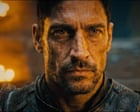
It’s certainly more epic than Musk’s production, consisting of two 17-minute episodes. Set in the 11th century, the show revolves around the historic Alamut Castle, although it’s entirely absent of any real sense of time or place. I was briefly intrigued by the opening images, with their bold palette of blues and mustard browns and yellows – but as soon as the “people” appeared, looking like Vaseline-smeared Madame Tussauds creations slowly melting in the sun, everything came crashing down.
There are lots of heady moments across the first two episodes of this oddly paced show, with cranky-looking men aplenty and over-milked visual metaphors involving the likes of snakes, blood and fire. Everything looks like it was cooked up with the prompt: “Give me eye-watering visuals.” The opening shot depicts an eagle being transported across a desert in a cage (“make it look cinematic”), followed by a longshot of the castle (“make it more cinematic”) then an aerial shot of men arriving on horseback (“make it MORE MORE MORE cinematic”).
We learn of the arrival in Alamut of a “freak” who “doesn’t eat or drink” and is intent on claiming these sweet digs for himself. This is Hasan Sabbah, who is supposed to be charismatic but looks plasticky and spectral, with a complexion like wet glue. He has somehow inspired an army of followers and ventures into the castle’s dungeons to recruit one more: the notorious warrior Azazil.
The frame is overloaded with grand and imposing imagery: when Azazil says goodbye to loved ones, of course the scene takes place in front of a milky sunset. When he fangs it across the desert on a horse at night, of course there’s a white full moon glowing resplendently above. When the doors of the mighty castle creak open, in the lead-up to a big moment in episode two, of course incandescent orange sunlight streams through the widening gap.
Make no mistake: the technology powering this is amazing and will profoundly alter the state of motion pictures. Productions like Castle Walls are among the first out of the gates, and therefore prone to snarky commentary. Perhaps AI will end up being broadly comparable to early silent films: revolutionary at the time, but quickly eclipsed by more sophisticated applications of the technology. But whereas the earliest motion pictures, famously dubbed the “cinema of attractions” by the historian Tom Gunning, provided some carnival-like wonder, these AI works tend to evoke a more cynical response from the general public. Viewers understandably seem less interested in what the technology promises than in what it threatens to take away: art imbued with humanity.
The sensible path forward is surely for human and machine to enter into a reciprocal and carefully collaborative process, where artists only use algorithms and prompts to enhance, rather than replace, human creativity. On that front, Castle Walls did use human voice actors and was reportedly written by actual human screenwriters: Kerem Deren and Çisil Hazal Tenim. “This is not a production that bypassed human skill; it is one that used AI to amplify it,” Ay Yapım has said.
But that’s hardly something to crow about, given how banal and chuckleheaded the writing is, puffed-up with lines like “I’ve stopped being a decent man” and “if I am the sheaf, you are the sword.” Were they really trying to make good art? Maybe that’s a question for ChatGPT.
- castle
- walls
- prime
- end
- series
- review
- vaseline
- mess