Save Hammersmith Bridge – but keep it free of cars
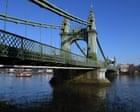
Readers respond to Simon Jenkins’s article on the west London crossing Simon Jenkins is a great defender of our national heritage, having produced many books on the subject and frequently written in the Guardian against aggressive modern architectural horrors. Well over half the households in Hammersmith and Fulham don’t have access to a car, and there are very good public transport links in the area; there is even a well-thought-out plan put forward by the Barnes Hammersmith Electric Light Transit group to run driverless electric “pod” vehicles to provide for those who are unable to walk…
Readers respond to Simon Jenkins’s article on the west London crossing
Simon Jenkins is a great defender of our national heritage, having produced many books on the subject and frequently written in the Guardian against aggressive modern architectural horrors. How shocking, then, to find him arguing for the replacement of Hammersmith Bridge simply to provide for yet more cars on the roads (Hammersmith Bridge is a symbol of our dysfunctional times. The money is there, the joined-up thinking isn’t, 23 October). He claims that the principal cause of congestion is “London’s epidemic of roadworks”, when actually it’s the fact that there are just too many cars trying to use a road network that isn’t designed for them.
Furthermore, he says that, in its present state, the bridge “merely allows pedestrians and cyclists to cross it” – and yet between 12,000 and 15,000 people use it every day. Reopening it to motor traffic (and increasingly heavy cars have massively contributed to the current state of degradation of the bridge) would bring little benefit. Well over half the households in Hammersmith and Fulham don’t have access to a car, and there are very good public transport links in the area; there is even a well-thought-out plan put forward by the Barnes Hammersmith Electric Light Transit group to run driverless electric “pod” vehicles to provide for those who are unable to walk across Hammersmith Bridge.
And quite apart from the huge difficulty involved in enabling the tearing down of a Grade II* listed structure (where’s our doughty defender of national heritage now?), there is no effective business case for replacing it at enormous cost to provide for yet more cars, when for both environmental and health reasons (particularly because of the pollution they cause), the whole emphasis should be on reducing our reliance on cars. If only someone in authority would summon up the courage to tackle the motoring lobby. Dr Richard Carter Putney, London
Simon Jenkins is right to castigate the different London authorities that have failed to replace Hammersmith Bridge over a period of seven years. No other capital city in Europe would allow such a prolonged truncation of a major transport artery, preventing vehicles from crossing the river. London is not a unitary authority and its mayor does not have the powers of his peers in other capitals to raise the finance to pay for the cost of a new bridge. The lack of joined-up thinking appears to be baked in to the planning processes of the different relevant authorities.
This sorry state of affairs in south-west London has led to permanent traffic chaos along the Upper Richmond Road and the hell that is Putney High Street during rush hour. Were it not for the British obsession for so-called “heritage” projects, we could have had a temporary bridge capable of carrying traffic years ago. Instead citizens are obliged to walk or pedal their way across a wonky bridge in order to get to the other side for the sake of a misplaced nostalgia for Victorian engineering feats. Julian Heddy East Sheen, London
The outdated photograph published with Simon Jenkins’s off-beam article on Hammersmith Bridge suggests decrepitude, when the reality is quite different. Thanks to £55m of investment by Hammersmith and Fulham council, this iconic, Grade II* listed bridge has found a successful new purpose as an active travel crossing, with 15,000 people a day walking and wheeling across its reopened main carriageway.
I know of no “growing body of opinion” calling for its replacement. On the contrary, the settled local preference has moved to build on this success with a proposal to introduce a fleet of lightweight, autonomous electric shuttles to fill the public transport gap to ensure all residents can cross comfortably and safely. Community-led Barnes Hammersmith Electric Light Transit is working with Ohmio UK and partners to deliver this vision.
Traffic on neighbouring bridges and the wider road network is down compared with before the bridge closed to motor vehicles, while Barnes’s local economy is booming, aided by the ebike revolution.
There is no credible business case for spending hundreds of millions bringing back polluting, dangerous and exclusionary through traffic. With the mayor targeting a 27% reduction in car traffic by 2030, the priority must be to build on this success, not undo it. Charles Campion Chair, Barnes Hammersmith Electric Light Transit
Simon Jenkins is a respected commentator on London’s heritage and built environment, with a deep understanding of the costs of maintaining historic infrastructure. We share his commitment to London’s bridges, but not his views on how the City Bridge Foundation’s charitable funds should be used.
We maintain five Thames bridges: Tower, London, Southwark, Millennium and Blackfriars, spanning centuries of engineering history. Their upkeep requires sustained investment and commitment, demonstrated by our current £15m Blackfriars Bridge refurbishment, repairing more than 2,000 cast-iron balusters and repainting the entire structure.
Our endowment exists to meet these responsibilities in perpetuity. It is not a general fund for London’s infrastructure, nor is its value a measure of money freely available to spend.
Alongside maintaining and supporting our bridges, where there are funds available, we make grants to charities tackling inequality and disadvantage across London. These funds are made for charitable purposes and governed by the legal and regulatory arrangements that apply to our work. They cannot simply be redirected to pay for the restoration or replacement of a bridge outside our remit.
We recognise the importance of London’s bridges to the people who rely on them every day, but other Thames crossings are the responsibility of other organisations. We share knowledge and experience with those responsible through industry groups.
For nearly 900 years, the legacy of Bridge House Estates has helped keep London’s bridges standing while supporting charitable work across the city. We are proud of this legacy and the charity partners working alongside us to build a fairer London. Paul Martinelli Chairman, City Bridge Foundation
- hammersmith
- bridge
- car
- save
- simon
- jenkins
- london
- road