Germany news: Gen Z group calls for new protests
The group behind German demonstrations this weekend has called for more protests to keep pressure on the government to act. Meanwhile, the IG Metall union has begun warning strikes after pay talks collapse.
Here is a roundup of top stories from and about Germany on the weekend of October 31 - November 1, 2026:
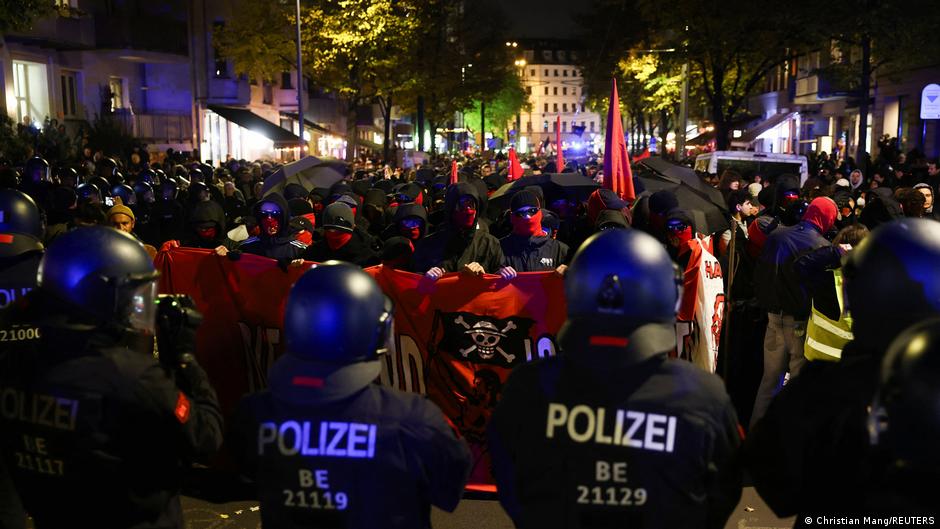
The group that organized this weekend's protests, "Gen Z regelt" roughly "Gen Z takes charge," distanced itself from violent riots that occurred after the rallies and called for new demonstrations later this month.
The initiative's organizers issued a positive assessment of protests across Germany.
"Today, 100,000 people showed why they're taking to the streets," a spokesperson for the initiative said Saturday, adding that estimates of participation in six to eight cities would come later.
Gen Z regelt planned protests in 34 cities, including Berlin, Frankfurt, Cologne and Munich, and has called for people to take to the streets again on November 14.
The group has called for more funding for schools, addiction treatment, and psychotherapy as well as measures to combat rising living costs. While it promotes social justice and greater climate protection, it opposes the introduction of mandatory military service, as well as an expansion of government surveillance.
"We are here today to fight for peace and freedom, rather than for war and coercion," Gen Z regelt spokesperson Lina Friedrich said Saturday in Berlin. "What matters most to us is better support for the health and education systems. We are against compulsory military service and we are in favor of a fairer distribution of the burden."
Gen Z regelt distanced itself from the violent riots and looting that followed the protests in some cities.
"We did not have any influence on what happened after the demonstrations," the group's spokesperson said.
Police also confirmed the demonstrations themselves were largely peaceful and that looting and riots afterward were set off by extremists using the protests for cover.
"The Gen Z protests turned out to be very peaceful," Andreas Rosskopf, chairman of the police union representing the Federal Police, told the Rheinische Post. He added that the groups responsible for the violence consisted of "autonomous and, in some cases, masked individuals."
In Cologne, which also saw looting, a police spokeswoman said the incidents were more likely linked to Halloween celebrations than to the aftermath of the Gen Z protests.
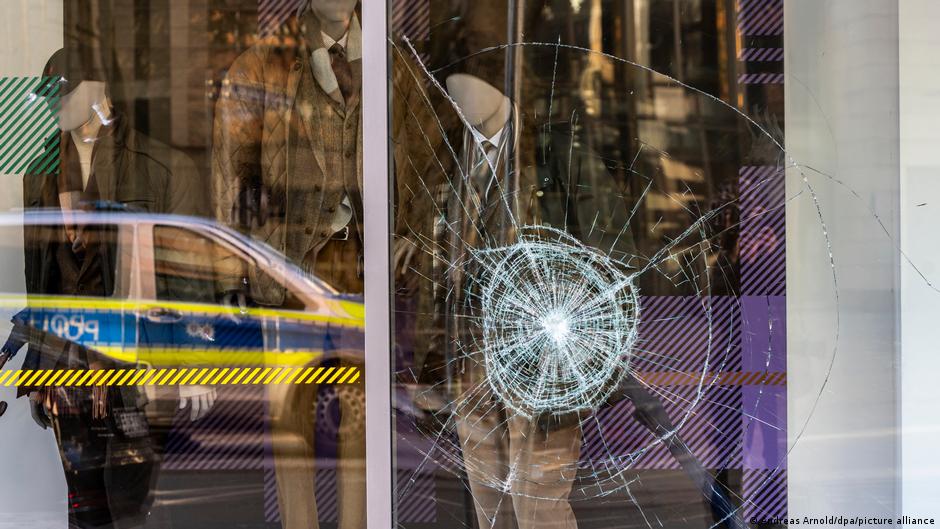
Police were patrolling the streets of downtown Frankfurt on Sunday morning, following looting that saw shop windows smashed and what a police spokesperson said was "considerable" damage to property.
The unrest followed demonstrations by young people demanding better schools, relief from rising living costs and greater social justice. Though the protests were largely peaceful, there were incidents of violence and rioting in Frankfurt and some other big German cities.
In Frankfurt, rioters smashed shop windows, stole goods from shops and attacked police officers. More than 30 people were detained and officers cordoned off parts of the city center. It was not immediately clear how many people were injured in the protests.
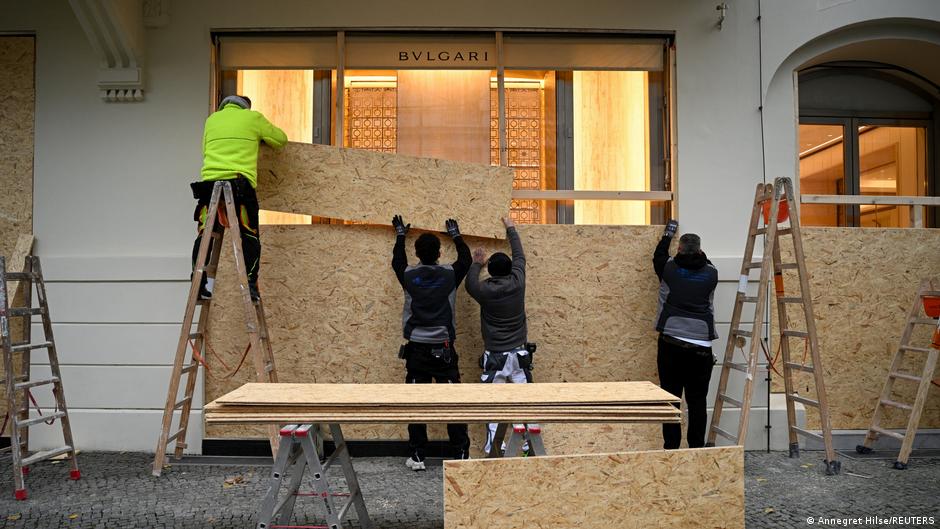
The police spokesperson said shops that were looted during the unrest also needed protection.
Hesse's state Premier Boris Rhein said he was shocked "by the violent excesses in Frankfurt," which "will not remain without consequences."
"Anyone who behaves like the attackers in Frankfurt's city center places themselves outside our society," Rhein said. "We will carefully assess the aggressors, perpetrator groups and the course of events, and draw our conclusions."
The group that organized the protests, "Gen Z regelt" roughly "Gen Z takes charge," had explicitly called for peaceful protests. German media in several cities observed extremists mixing into crowds of peaceful protesters.
Germany's IG Metall union began limited "warning strikes" in the metalworking and electrical sectors at midnight on Sunday.
The strikes began with about 300 night-shift employees at a factory in the western German state of Rhineland-Palatinate holding a rally outside the facility's entrance. A protest also began overnight at the mobile communications supplier RF 360 Europe/Qualcomm in Munich.
The warning strikes are set to spread across Germany next week. IG Metall is Germany's largest union and represents about 3.7 million workers in industrial sectors such as automotive manufacturing, mechanical engineering, electronics, and metal production.
The union has demanded a 5% pay increase over 12 months, as well as job and plant security.
In the second round of negotiations, employers presented an offer that included a one-time payment next year and a 1.3% step increase in July 2028, saying industry faced high cost burdens operating in Germany.
Union Chair Christiane Benner announced "major warning strikes" because the "so-called offer" met only with "incomprehension" in the workplaces, as the pay increases were well below the rate of inflation in Germany.
The Left Party in Berlin overwhelmingly voted in favor of formal talks to form a three-party coalition government with the Greens and Social Democrats.
Negotiations could begin on Monday as the Greens and SPD both already agreed to open formal talks for a government led by The Left in the city-state.
"We will not let ourselves be ground down, and I will not give up," Elif Eralp, The Left's parliamentary group leader, told party members during a congress on Saturday. She aims to be Berlin's first governing mayor from her party.
"Not a day passes without someone trying to force us and me to give up," she said, accusing Chancellor Friedrich Merz of trying to "blackmail" the Greens and SPD into abandoning plans for a coalition.
The Left emerged as the strongest party with 25.7% of the vote in the state elections on September 20. Merz's conservative Christian Democratic Union (CDU) followed with 18.8%, the anti-immigrant Alternative for Germany (AfD) with 16.3%, the Greens with 14.3% and the SPD with 12.1%.
"The people of this city voted for us for change, and we will implement it," Eralp said. "They rightly expect us to pull every lever to improve their lives."
The three parties are expected to base their coalition negotiations on a preliminary agreement presented two weeks ago.
Its most controversial proposal would see around 160,000 flats owned by five major property companies transferred into public ownership in exchange for compensation.
Ahead of Saturday's vote, Berlin's Left Party has been dogged by allegations of antisemitism as well as a debate over Eralp's independence and ability to address crime in the capital after Der Spiegel published her interview comments indicating she chose not to mention a pro-Palestinian activist by name due to fears for the safety of her family.
We've been busy covering Gen Z protests in Germany in a separate blog.
The demonstrations were largely peaceful throughout the day, but reports switched to instances of violence and rioting in some cities, especially Frankfurt and Cologne, as night fell.
Youth protests have begun in cities across Germany, with demonstrators demanding better-funded schools, action on living costs and stronger climate protection. They also oppose a possible return to military conscription.
A railway crossing barrier just 46 centimeters (18 inches) long has become an unlikely selfie attraction in Cologne — but the city's transport operator says it serves a purpose.
The miniature arm stands beside tracks leading to a tram maintenance depot in the Weidenpesch district. It has even appeared on Google Maps as "Germany's smallest barrier."
Despite online mockery, it is no mistake. "It serves as a placeholder," said Cologne transport operator KVB spokesman Stephan Anemüller.
Installed in 2020, the barrier is to be extended once a planned cycle path is built alongside a nearby housing development. That avoids having to overhaul the crossing equipment later.
KVB is enjoying the attention. Anemüller called it "an amusing attraction" and said the operator would try to secure it a place in Cologne's city museum when it is eventually removed.
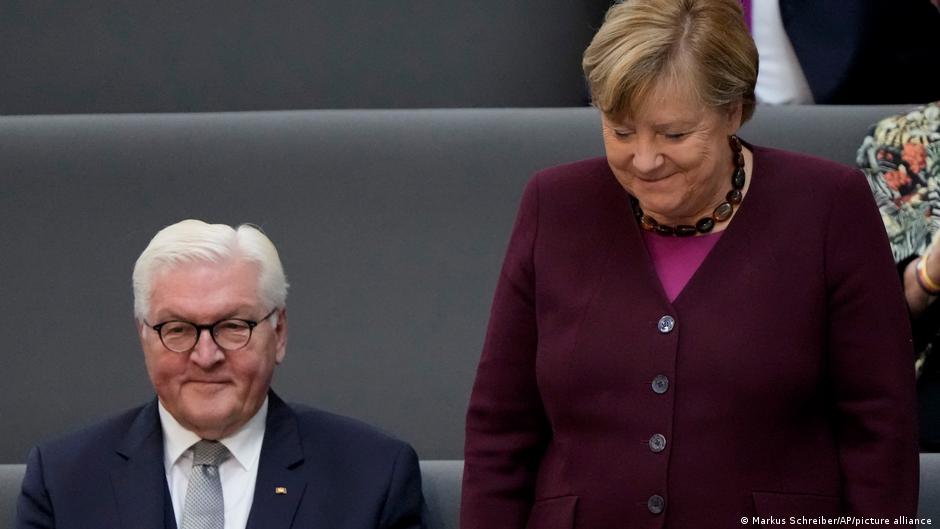
Former German Chancellor Angela Merkel has called for a woman to succeed President Frank-Walter Steinmeier, pointing out that no woman has held the office in the country's 77-year history.
Everyone should ask "whether it might finally be time," Merkel told MagentaTV.
She said she knew women capable of doing the job but declined to name anyone.
The Federal Convention elects Germany's next head of state on January 30. Steinmeier cannot seek a third consecutive term. The presidency is mostly a ceremonial role.
Bavarian parliamentary speaker Ilse Aigner has the backing of Markus Söder, leader of the conservative Christian Social Union (CSU).
Other names being discussed include Bundestag president Julia Klockner, Education Minister Karin Prien and former Defense Minister Annegret Kramp-Karrenbauer, all from Merkel's center-right Christian Democratic Union (CDU).
Merkel described the debate as "strange" and criticized its "unpleasant undertone."
She also challenged her party's direction, saying the CDU's identity went beyond economic policy. "The CDU was always about building bridges to all parts of society — and that must be brought back to the forefront."
Berlin's socialist Left Party is expected to approve coalition negotiations with the center-left Social Democratic Party (SPD) and environmentalist Greens, potentially paving the way for the city's first Left Party mayor.
The SPD and Greens have already backed talks, which could begin on Monday. But the Left Party's youth wing opposes the alliance, calling instead for a "strong socialist opposition."
Delegates gathered under tight security in Berlin's Lichtenberg district following calls for protests accusing the party of betraying voters. Its candidate for mayor, Elif Eralp, has been given personal protection.
The Left Party won September's election with 25.7% of the vote. The governing coalition of the center-right Christian Democratic Union (CDU) and SPD lost its majority.
If the three parties reach a deal, Eralp, currently the Left Party's parliamentary leader in Berlin, could become the city's next governing mayor.
Germany has never had a woman as its head of state. Former Chancellor Angela Merkel thinks it might be time to change that.
Merkel, who was Germany's first female chancellor, has called for a woman to succeed President Frank-Walter Steinmeier.
Meanwhile, could Berlin be heading for its first mayor from the socialist Left Party?
Stay with us here for these stories and more of what Germany is talking about today.
- group
- germany
- news
- gen
- protest
- demonstration
- weekend
- pressure