Indonesia's toxic haze is giving its neighbours a political headache

Governments in Singapore and Malaysia are split between anxious citizens and an irascible neighbour.
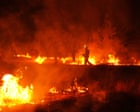
The haze billowing out from wildfires in the Indonesian regions of Kalimantan, Papua and Sumatra knows no borders.
Carried by winds to nearby Singapore and Malaysia, the toxic smog has in recent weeks impacted populations across maritime South East Asia, triggering respiratory illnesses and headaches.
It's also giving the region's governments a different kind of headache - split between the mounting frustrations of their citizens and the risk of souring diplomatic ties with Indonesia.
"People are fed up, angry and anxious," Eugene Tan, associate professor of law at the Singapore Management University, tells the BBC. "The governments have to respond to them, or else what is more an external issue has become an internal one with ample headroom for politicisation."
Indonesia's wildfires are a yearly occurrence, widely associated with industrial-scale land clearing to make way for crops like oil palm.
But the blazes this year have been particularly difficult to tame due to a strong El Niño, which has exacerbated drought conditions in the country's forests and peatlands.
Whereas previous haze episodes in Singapore and Malaysia have typically lasted for a few days, this time it stretched into weeks.
In Malaysia, locals started a boycott of Indonesian products in protest against the haze, after lawmaker Syed Saddiq called for sanctions on companies linked to the wildfires and said Malaysians should "treat them as an outcast in the region".
There have also been complaints in Singapore, a country that has come to expect seamless efficiency from its leaders.
"There appears to be the view that the government dropped the ball in dealing with the haze, given that it was known that the El Niño weather phenomenon would be severe and that early warning was given," says Tan.
"Clearly, Singaporeans expect the government to decisively deal with the polluters."
Singapore's government, for its part, has made it clear that the haze problem is a priority.
Hundreds of haze shelters have been set up across the island, and masks are being distributed to children, the elderly and other vulnerable residents.
Authorities have also said they're looking to strengthen existing haze legislation and are investigating 10 Singapore-registered companies for potential links to the wildfires in Indonesia.
Last week, Singapore's foreign minister Vivian Balakrishnan met Indonesian President Prabowo Subianto in Jakarta for what the former described as "honest" and "sincere" conversations that produced "constructive approaches".
The meeting came as both countries announced they would set up a joint task force to deal with the haze - an apparent détente after weeks of simmering bilateral tensions.
As the haze spiralled into yet another crisis for Prabowo's beleaguered administration, some officials pushed back against criticism.
One senior official ruffled feathers when he said the wildfires were out of human control and that oxygen in neighbouring Singapore and Malaysia "also comes from our forests".
That remark was "disappointing" and "not right", according to Singaporean senior minister K Shanmugam - a rare rebuke from the city state, which prides itself on its diplomatic prowess.
"The haze is affecting our health seriously, and it's really unacceptable," Shanmugam told reporters. Since the haze impacts citizens on both sides of the border, there should not be "any bilateral issues" in addressing it, he added.
"The Indonesian public is suffering as well, and it is in Indonesia's interest as much as ours to deal with the companies that are causing these problems."
Days later, Indonesia announced it would reduce gas exports to Singapore, citing domestic energy needs - a move that many saw as retaliation to Singapore's rhetoric.
To be sure, Indonesia has faced recent electricity shortages in parts of the country. Singapore also says the reduction, which amounts to less than 2% of its total daily demand, will have little impact on its gas supply.
But the abrupt announcement came just days after Indonesia's energy minister warned that they could halt gas exports to countries that don't "respect Indonesia". That same day, Prabowo made reference to "countries that like to insult Indonesia" when talking about the wildfires.
"It's a tired playbook of using Singapore as the bogeyman, driven by the 'abang-adik' [big brother-little brother] syndrome," Tan says, referring to a historical dynamic that Singapore's leaders have long tried to shrug off: the expectation that it should defer to its larger neighbours.
"Singapore leaders expressing concerns about the haze and how it affects the people of both countries have been taken to mean that Singapore has been disrespectful to its neighbour."
In contrast, Malaysia's official rhetoric on the haze has been relatively muted.
Its foreign minister Mohamad Hasan has ruled out lodging a formal diplomatic protest with Indonesia or taking legal action, saying such actions "would mean we were prepared to sever relations".
For now, Malaysia has agreed to explore a memorandum of understanding with Indonesia to strengthen wildfire prevention efforts.
It would also rely on diplomatic mechanisms, Mohamad said - like the Asean Agreement on Transboundary Haze Pollution.
The agreement, which came into effect in 2003, commits members of the Association of Southeast Asian Nations (Asean) to collaborate on tackling the recurring haze.
But many see it as toothless, as it is unable to punish agricultural companies linked to wildfires or to force individual governments to do so.
The agreement has turned out to be "just not worth the paper it was signed on", says James Chin, professor of Asian studies at the University of Tasmania.
"The moment the haze disappears, the moment the political pressure's off, it's back to business as usual."
In 2016, Asean countries had set a goal to eliminate haze in the region by 2020. When that deadline drifted quietly by, they set a new target of achieving the goal by 2030 instead.
Complicating Malaysia's position is the fact that it is also a major palm oil producer. The commodity is often linked to commercial "slash-and-burn" practices that are widely blamed for the region's wildfires.
Malaysia has at times dealt with acute haze stemming from blazes on local land.
In 2019, when Malaysia pointed to hotspots in Indonesia's peatlands as the cause of the haze shrouding the region, Indonesian authorities pointed the finger back at Malaysia, claiming the smog came from their side.
"As long as we place a lot of importance on oil palm planting, [the haze] is going to recur," says Ei Sun Oh, principal adviser at the Pacific Research Centre of Malaysia.
And even if Malaysia were to speak up, Oh adds, it's unlikely to wield the same "leverage" over Indonesia as Singapore, which is Indonesia's largest foreign investor and an offshore financial hub for many wealthy Indonesians.
For now, Malaysia "doesn't want to unduly provoke Indonesia", says Oh.
"The government is just wringing their hands till the wind blows [the problem] over. Because eventually it will blow over."
Borneo burning: Life on the frontline of South East Asia's toxic haze
Who's to blame for the toxic haze choking South East Asia?
Desperate to clear toxic haze, Indonesia douses its skies with dry ice
- haze
- neighbour
- headache
- indonesia
- government
- singapore
- malaysia
- citizen