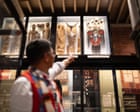
‘The lack of fun is as noticeable as the lack of content’: the reborn Museum of London is all piazza, no punch

London Museum Smithfield Why has the revamped museum divided its exhibits into nonsensical themes and shunted all the fascinating stuff downstairs? So now we get the rebranded and reimagined London Museum Smithfield.
London Museum SmithfieldWhy has the revamped museum divided its exhibits into nonsensical themes and shunted all the fascinating stuff downstairs? The results are baffling, unengaging and soulless
The Museum of London at the Barbican was the capital’s local museum, a crowded and quirky presentation of its history from the Dagenham idol to Vauxhall Pleasure Gardens. But apparently the location deterred casual visitors, and maybe it just wasn’t grand enough to reflect London’s self-conscious significance. For not since ancient Rome has a capital dominated its nation’s history and culture like London. So now we get the rebranded and reimagined London Museum Smithfield.
History surrounds you in this neighbourhood: Black Death burials by the Charterhouse, the Knights of St John, the Smithfield martyrs, William Wallace’s execution site. So goodbye scruffy brutalist Slough House location, hello deep history. Except when you enter the new museum, all that history, all those layers going back to the Romans and earlier, have been brushed away. If you want an illustration that bigger is not better, this is it. When Sharon Ament, the director, asked me if I liked it, I couldn’t find the words. I was heartbroken, speechless, unlike the museum’s management who have their own way with language. Displays have nonsensical themes: “London as Ritual”, “London as Stage”, “London as Sunrise”. One wall text begins: “London is a city of people.” Read that twice. What is this? Cunk on London?
Two vast ground floor spaces are called Real Time and Our Time. Neither has much to see in the way of exhibits – a bell, a stuffed giraffe, the Lord Mayor’s coach in an absurd vitrine. But that’s not the point, for really they are all about the cafes and restaurants, chill-out spaces and vibing. I was proudly told the 24-hour Temperance cafe will serve people coming out of nearby Fabric.
This place wants to be up there with the club, to be more than a stuffy old museum. It ends up being so much less. It strains to be part of the city and definitely is a good indoor piazza to hang out, have coffee, read your texts. But so is nearby St Pancras station and it has more respect for its Victorian heritage.
Where is the heart of this museum, its vast and fascinating collection of artefacts from London’s long history and even prehistory? That has been shoved downstairs into a third space called Past Time. The assumption seems to be the past is dead in contrast to the living present, though surely history is the process of change in which we all live.
Past Time doesn’t have galleries of different periods: just one long open space telling the entire story of London in a potted, bullet-point version addressed to someone who in the curators’ imaginations can’t cope with the least hint of complexity. I say entire, but it cuts out the prehistory of the Thames landscape, which got its own gallery in the old museum. Ament told me that the gallery was not “popular”, so it’s sayonara to the stone age handaxes.
Yet the lack of fun is as noticeable as the lack of content. I may have made the old Museum of London sound serious, but it found space for a son et Lumiere 18th-century pleasure garden, Victorian shops, a Roman house. There’s nothing like that here. Instead everything is presented with chic conceptualism, like a taster menu. There is a Roman shop and tavern, yet this is done in such a minimalist, cool way it has no atmosphere. Kids will shrug.
The whirl through time continues as medieval London is jumbled into the Tudors and Stuarts. In next to no time, you reach a single case covering both world wars. Well, I don’t suppose they made much impact on London … but wasn’t there a blitz or something? The lack of space or time to explore the collections in depth destroys any chance to connect with objects emotionally: as you proceed from chronological displays to themed ones, the randomisation is numbing.
London is a venerable place yet also a city of amnesias. Accidental destruction by the Great Fire and attempted obliteration by Nazi bombs are not the only enemies of its past. Many medieval and Tudor buildings were demolished by the Victorians and today the character of whole neighbourhoods is casually undermined by cynical building – it recently took Mick Jagger to stop a tower dominating the riverside at Chelsea. So a London Museum is necessary, a place where Londoners and visitors to the “monster city”, as Defoe called it, can understand its immense yet fragile history.
But the London Museum treats it as an eternal entity, always in the now, never changing. A painting of the Annunciation, a Roman inscription, modern badges are shoved together in London as Ritual but don’t spark new meanings by being juxtaposed. Everything starts to feel meaningless: Punch and Judy next to a painting of an ice fair, a mannequin of the actor Edmund Kean, Charles Booth’s map of London wealth – the supposedly imaginative rejection of chronology is just baffling and disengaging.
It’s one thing to lack a brain but this museum has lost its soul. At least if you live far outside the capital and are sick of London getting all the fuss, you can take satisfaction that your own local museum is almost certainly more interesting and charming than this.
- london
- museum
- history
- lack
- smithfield
- fun
- content
- reborn