


Samsung
Galaxy Z Fold 8 Ultra
The Samsung Galaxy Z Fold 8 Ultra has better camera specs and a larger battery than its little brother, but its dimensions aren’t as well-suited for video streaming and it costs more.
Benefits
- Includes telephoto lens
- 5000 mAh high capacity battery
- Large screens
Disadvantages
- Very expensive
- Large size won’t fit everyone
The Samsung Galaxy Z Fold 8 is smaller than its Ultra counterpart and doesn’t have a telephoto lens, but it also costs less, has just as much power, and has a compact screen that may suit some users better.
Benefits
- Lower price than Z Fold 8 Ultra
- High-end power
- More user-friendly than Ultra
Disadvantages
- No telephoto lens
- Smaller battery than Ultra
Samsung has revealed three new foldable phones: the Samsung Galaxy Z Fold 8, the Samsung Galaxy Z Fold 8 Ultra, and the Samsung Galaxy Z Flip 8. And while the last of this trio falls into its own category, the first two phones have a lot in common.
Besides having similar names, they are both foldable into a book shape and also share many specifications. But between very different form factors and differences in the respective camera configurations, there is also a lot to differentiate.
So, below we have compared the Samsung Galaxy Z Fold 8 and Galaxy Z Fold 8 Ultra, so you can easily understand how they compare. We haven’t yet reviewed either model, but we have worked with both and have thus been able to draw some initial conclusions as to who they are best suited for.
Samsung Galaxy Z Fold 8 Ultra vs Samsung Galaxy Z Fold 8: Specs comparison
Before we take a closer look at the main features of these two phones, we’ve detailed their main specifications below, so you can see their main similarities and differences at a glance.
Drag to scroll horizontally
| Header Cell – Column 0 | Samsung Galaxy Z Fold 8 Ultra | Samsung Galaxy Z Fold 8 |
|---|---|---|
Dimensions (unfolded): | 158.4 x 143.2 x 4.1mm | 161.4 x 123.9 x 4.5mm |
Dimensions (folded): | 158.4 x 72.8 x 8.9mm | 81.9 x 123.9 x 9.7mm |
Weight: | 215g | 201g |
Foldable screen: | 8.0-inch AMOLED display, 2256 x 2504, 120Hz | 7.6-inch AMOLED display, 1828 x 2448, 120Hz |
Cover screen: | 6.5-inch AMOLED display, 1080 x 2520, 120Hz | 5.5-inch AMOLED display, 1248 x 1972, 120Hz |
Chipset: | Snapdragon 8 Elite Gen 5 for Galaxy | Snapdragon 8 Elite Gen 5 for Galaxy |
RAM: | 12 GB / 16 GB | 12 GB / 16 GB |
Rear cameras: | 200MP wide, 50MP ultra-wide, 10MP telephoto | 50MP wide, 50MP ultra-wide |
Front camera: | 10MP and 10MP | 10MP and 10MP |
Battery: | 5000mAh | 4,800mAh |
Loading: | 45W wired, 20W wireless | 45W wired, 20W wireless |
Storage: | 256GB/512GB/1TB | 256GB/512GB/1TB |
Samsung Galaxy Z Fold 8 Ultra vs Samsung Galaxy Z Fold 8: price and availability
Image 1 of 2

The Samsung Galaxy Z Fold 8 Ultra and Samsung Galaxy Z Fold 8 were both announced on July 22, with pre-orders opening the same day.
General availability for both phones starts on August 7, but if you pre-order you might get them sooner – at the time of writing we’re predicting a delivery date of August 3 in the UK, for example.
As for price, the Galaxy Z Fold 8 starts at $1,899.99 / £1,699 / AU$2,699. The Galaxy Z Fold 8 Ultra is more expensive, with a starting price of $2,099.99 / £1,899 / AU$2,999. Either way, that’s 256GB of storage, although you can choose either model in 512GB and 1TB configurations.
So, in other words, the Galaxy Z Fold 8 Ultra starts at $200 / £200 / AU$300 more than the standard Galaxy Z Fold 8.
Drag to scroll horizontally
Storage | American price | Prices in the UK | AU Price |
|---|---|---|---|
256 GB | $2,099.99 | £1,899 | AU$2,999 |
512 GB | $2,299.99 | £2,069 | AU$3,299 |
1 TB | $2,699.99 | £2,409 | AU$3,899 |
Drag to scroll horizontally
Storage | American price | Prices in the UK | AU Price |
|---|---|---|---|
256 GB | $1,899.99 | £1,699 | AU$2,699 |
512 GB | $2,099.99 | £1,869 | AU$2,999 |
1 TB | $2,499.99 | £2,209 | AU$3,599 |
Samsung Galaxy Z Fold 8 Ultra vs Samsung Galaxy Z Fold 8: design
Image 1 of 2

In some ways, the Samsung Galaxy Z Fold 8 Ultra and Samsung Galaxy Z Fold 8 have similar designs: after all, they are both foldable phones that fold and unfold horizontally like a book. However, their shapes and dimensions differ greatly.
The Samsung Galaxy Z Fold 8 Ultra looks a lot like the Samsung Galaxy Z Fold 7, with a tall and narrow design, leading to dimensions of 158.4 x 143.2 x 4.1mm when unfolded, 158.4 x 72.8 x 8.9mm when folded and a weight of 215g.
The Samsung Galaxy Z Fold 8, on the other hand, is shorter and wider, looking more like a passport than a book, with dimensions of 161.4 x 123.9 x 4.5 mm when unfolded, 81.9 x 123.9 x 9.7 mm when folded and a weight of 201 g.

Both phones, however, have an IP48 rating, meaning they are resistant to water to depths of 1.5 meters for up to 30 minutes, as well as dust and other objects larger than 1mm.
They also both have aluminum frames and share Samsung’s Flex Titanium technology, meaning their hinges are also invisible (you’ll notice their respective hinges from certain angles, but Samsung has come a long way in this department since the days of the original Galaxy Fold).
As for colors, while the Samsung Galaxy Z Fold 8 Ultra is sold in Graphite, Cream, Green Shadow and Violet Shadow shades, the Z Fold 8 can be purchased in Graphite, Cream, Lavender and Pistachio shades.
Samsung Galaxy Z Fold 8 Ultra vs. Samsung Galaxy Z Fold 8: Display
Image 1 of 2
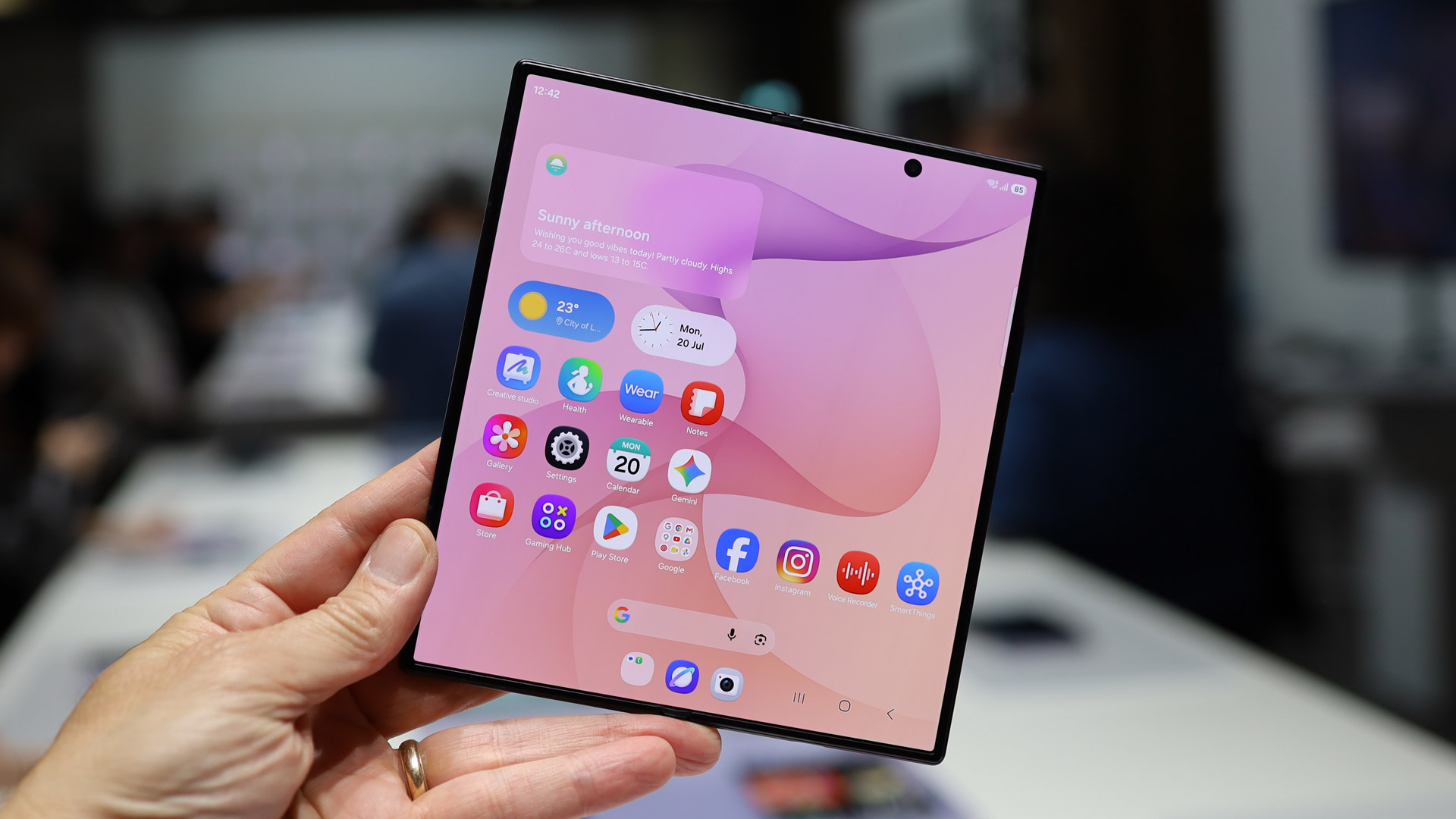
Now let’s move on to the biggest difference between these two phones: their screens. Or rather, the form and purpose of these displays.
The Samsung Galaxy Z Fold 8 Ultra features an 8.0-inch 2256 x 2504 foldable AMOLED display and a 6.5-inch 1080 x 2520 AMOLED cover display, both with a 120Hz refresh rate and approximately 422 pixels per inch.
The Samsung Galaxy Z Fold 8 features a 7.6-inch 1828 x 2448 foldable AMOLED display with approximately 403 pixels per inch and a 5.5-inch 1248 x 1972 AMOLED cover display with approximately 428 pixels per inch.
So both screens on the standard Z Fold 8 are noticeably smaller, but the proportions arguably make a bigger difference, with the Galaxy Z Fold 8 Ultra having a nearly square 1.11:1 foldable screen and a narrow 21:9 cover screen.
Image 1 of 2

The Samsung Galaxy Z Fold 8, on the other hand, has a 4:3 foldable display, ideal for widescreen content, and a 10:16 cover display, which is a bit squarer than a typical phone and can be easily covered up and down with one hand.
The taller and narrower Galaxy Z Fold 8 Ultra has its own size advantages. It’s harder to stretch your thumb to the top of this phone’s screen, but it’s easier to cover it with one hand from left to right. And when open, the Ultra is best suited to productivity apps that display square-shaped content like spreadsheets.
For video streaming, you’ll want to opt for the Galaxy Z Fold 8, as most video content is displayed in 16:9 (you’ll see smaller black bars on a 4:3 screen), and it’s arguably also the phone best suited for gaming.
Samsung Galaxy Z Fold 8 Ultra vs. Samsung Galaxy Z Fold 8: Cameras
Image 1 of 2

There are big differences between the cameras on these two phones, with the Samsung Galaxy Z Fold 8 Ultra coming out on top. This device has a 200MP f/1.7 wide camera, a 50MP f/1.9 ultra-wide with a 120-degree field of view, and a 10MP f/2.4 telephoto lens with 3x optical zoom. It also has a 10MP selfie camera on each screen.
The Samsung Galaxy Z Fold 8 has a smaller camera and fewer megapixels in its wide device. Specifically, you get a 50MP f/1.8 wide camera, a 50MP f/1.9 ultra-wide with a 120-degree field of view, and two 10MP selfie cameras. It therefore lacks the telephoto lens found on the Ultra.
However, both phones are capable of recording video in quality up to 8K at 30fps, or 4K at up to 120fps.
We haven’t had a chance to test the cameras on either phone yet, but we’ll update this article with images when we do. The Galaxy Z Fold 8 Ultra will, for obvious reasons, be the better zoom camera, but there probably won’t be too much choice between the phones’ 200 MP and 50 MP wide cameras, as both will default to smaller photo sizes, as is common practice for modern smartphones.
Samsung Galaxy Z Fold 8 Ultra vs Samsung Galaxy Z Fold 8: performance and software
Image 1 of 2

There’s nothing to choose from here, with both the Samsung Galaxy Z Fold 8 Ultra and Z Fold 8 having a Galaxy Snapdragon 8 Elite Gen 5 chipset and 12GB of RAM – unless you get a 1TB model, in which case you’ll get 16GB of RAM.
This combination of specifications will ensure top-of-the-line performance no matter what you do on your phone, and in our short time with both x devices, they are equally capable gaming phones and productivity powerhouses (despite their respective screen sizes, which make them each better suited to different tasks).
The Galaxy Z Fold 8 Ultra and Galaxy Z Fold 8 also run Android 17 layered on top of One UI 9 and promise seven major Android upgrades.
Samsung Galaxy Z Fold 8 Ultra vs Samsung Galaxy Z Fold 8: battery
Image 1 of 1

Samsung has finally started installing silicon-carbon batteries in its phones, enabling higher capacity batteries with the same footprint. As a result, it managed to fit a 5,000 mAh battery into the Galaxy Z Fold 8 Ultra (compared to 4,400 mAh in the Z Fold 7).
Unsurprisingly, the smaller Samsung Galaxy Z Fold 8 has a lower capacity battery (4,800 mAh), which should help the Ultra last a little longer – but not by much.
Samsung claims that the Galaxy Z Fold 8 Ultra will give you 27 hours of video playback, while the standard Galaxy Z Fold 8 is rated at 26 hours. In our initial anecdotal testing, we managed to use both phones for several days without needing to charge them, so these reading estimates are likely accurate.
Both phones also support up to 45W wired charging and 20W wireless charging, so you won’t lose charging speed by choosing one phone over another.
Samsung Galaxy Z Fold 8 Ultra vs Samsung Galaxy Z Fold 8: early verdict
The Samsung Galaxy Z Fold 8 Ultra has larger, more productive screens than the Galaxy Z Fold 8, as well as an additional camera, more megapixels in its wide camera, and a slightly higher capacity battery. However, it also costs $200/£200/AU$300 more and offers identical power.
Its larger screens won’t be desirable for everyone either – indeed, the Galaxy Z Fold 8’s screens are much more video-friendly and could soon become the standard for foldables – so the only clear advantages of the more expensive model are its cameras and larger battery (although on the latter we’re talking about fine margins).
Whether these extra features are important enough to justify the Galaxy Z Fold 8 Ultra’s higher price will of course be subjective, but you may want to wait for our full reviews to see how these two phones compare in practice.

Follow TechRadar on Google News And add us as your favorite source to get our news, reviews and expert opinions in your feeds.



