


An ancient, gigantic black hole threatens to upend cosmic history
The debate still revolves around the nature of the “little red dots”, black holes seen in the early universe by the James Webb space telescope. Controversial new weigh-in could settle the question
By Joseph Howlett edited by Lee Billings
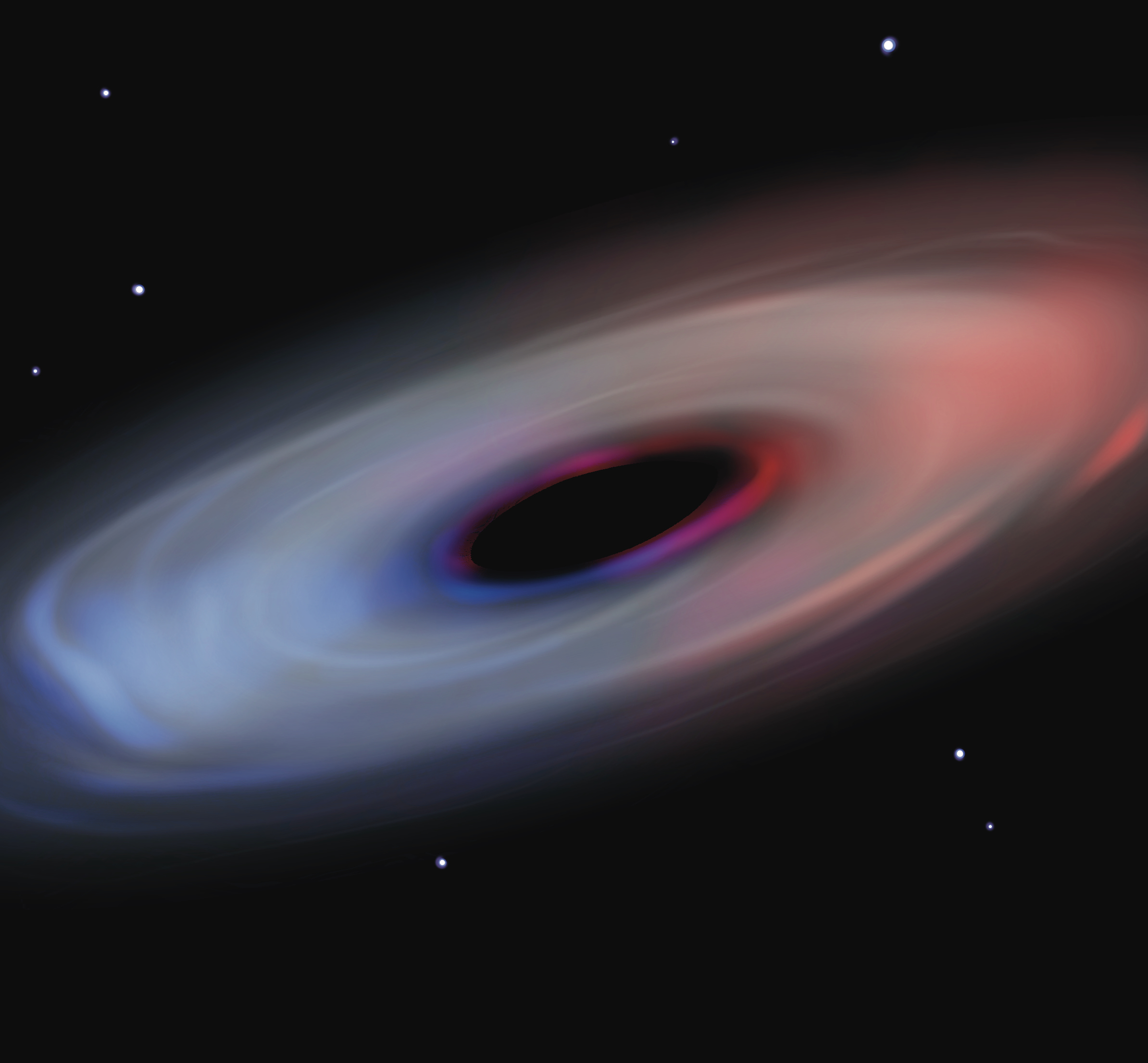
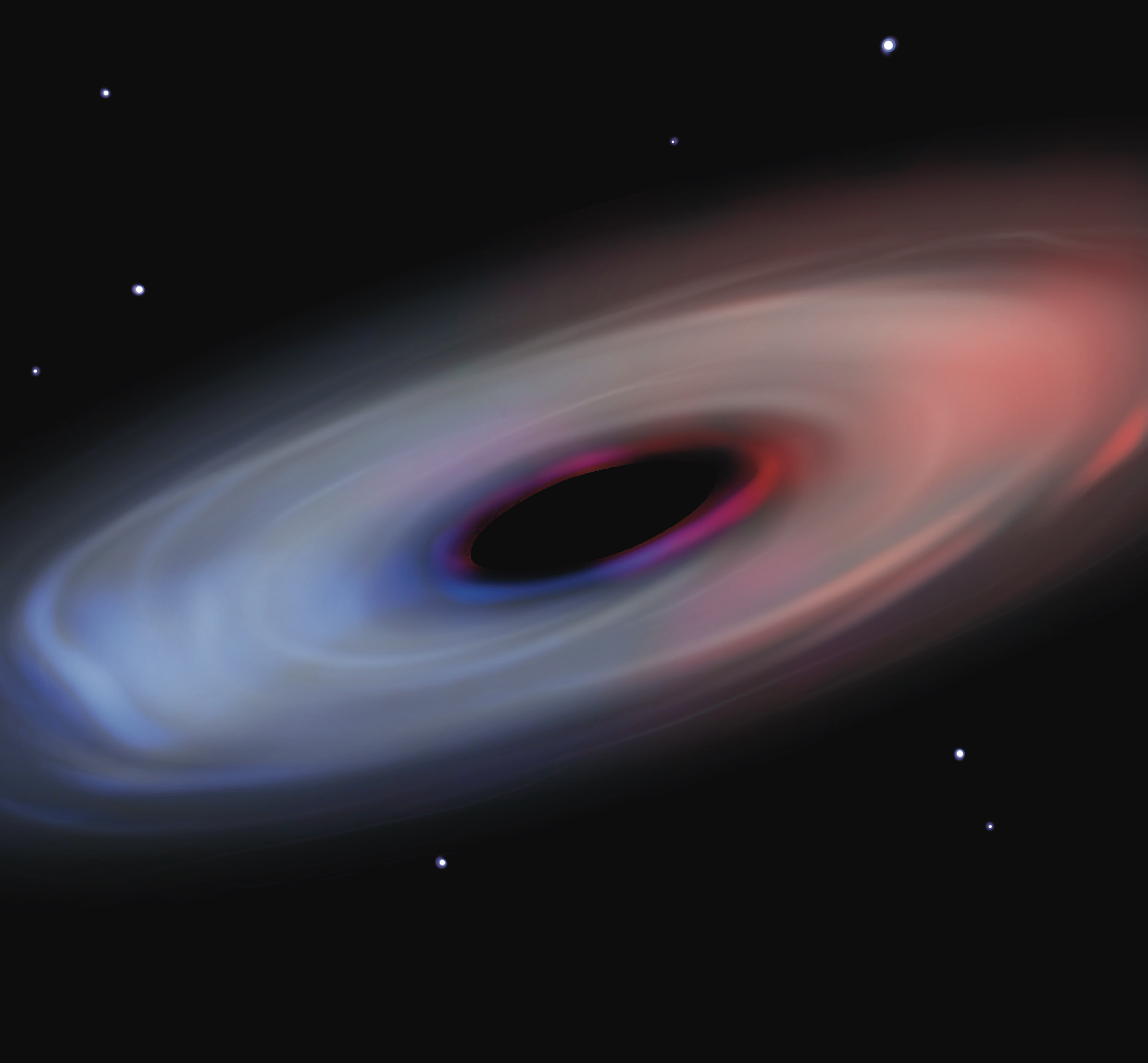
An artistic conception of gas swirling around a “little red dot”, with colors showing the different light colors of the components swirling towards and away from us.
Jiarong Gu
The mystifying final inhabitants of the universe continue to baffle and divide astronomers.
Almost as soon as NASA’s James Webb Space Telescope (JWST) turned on in 2022, collecting light from the first billion years after the big bang, it saw an ancient sky adorned with tiny, bright red spots. Since then, these “small red dots» (LRD) have called into question virtually everything scientists thought they knew about the early universe.
Most astronomers now agree that each of these tiny crimson spots, which bear a striking resemblance to enormous, distant stars, actually has a burgeoning black hole at its center. But the size of these black holes – and therefore their origin and role in the grand arc of cosmic history – remains a problem. the subject of intense debate.
On supporting science journalism
If you enjoy this article, please consider supporting our award-winning journalism by subscribe. By purchasing a subscription, you are helping to ensure the future of impactful stories about the discoveries and ideas shaping our world today.
A paper published today in Nature claims the “heavy” side of this cosmic competition guess my weight. Using JWST to go back to just 700 million years after the big bang, the paper’s authors report their measurement of the mass of an LRD by a new, allegedly less equivocal method: they found that it is about 50 million times the mass of our sun. The result has been met with skepticism since it emerged as a preprint however, last August, because its conclusions would upset the beliefs of most astronomers. The discovery of such massive black holes so early in the life of the universe would suggest that they predate the galaxies that engulf them and may have originated around the same time. the dawn of time itself.
“If everything said in this article is true on its face, then we live in an alien world,” says Jenny Greene, an astronomer at Princeton University, who was not involved in the study. “That’s why it’s very important.”
The debate boils down to which came first: the vast agglomerations of stars and gas we call galaxies or the giant black holes we usually see at their hearts. If black holes appeared first, serving as gravitational seeds for the growth of galaxies, then they must have become very large very early in the life of the universe.
Following the researchers’ discovery, initial follow-ups suggested that the LRDs each weighed millions of solar masses – a potential pivot in this controversial “black holes first” timeline. But astronomers later disputed these initial estimates. These early attempts to measure LRD masses used an indirect technique common for weighing black holes in later, more contemporary cosmic epochs: the “supermassive” black holes at the center of each galaxy. But this technique assumed that LRDs had a similar environment to their modern counterparts.
Unlike supermassive black holes, critics say, LRDs appear obstructed by much denser clouds of gas, which could require a more direct method to accurately measure their mass. Many of these critics believe that LRDs constitute a completely new class of objects called “black hole stars.” From the outside, a black hole star would look a lot like a red giant star: a luminous, bloated ball of ionized gas. But instead of concocting thermonuclear fusion reactions in its invisible core like an ordinary star would, an LRD would host a…but not adult—a black hole at its heart. Feasting on gas, this baby black hole would generate enough energy to support the surrounding cocoon and maintain its glow.
Either explanation would constitute an astrophysical revolution. If these black holes reached several million solar masses so soon, their origin would become even more mysterious. “It takes you back to exotic stuff,” Greene says.
Assigning LRDs a smaller size avoids the problem of black holes proliferating almost inexplicably, but only by presenting them as an unprecedented new celestial species: the black hole star. “There is a tendency to reclassify well-known phenomena as something new,” says Roberto Maiolino, an astrophysicist at the University of Cambridge and co-author of the study. Nature study. Cambridge Ph.D. student Ignas Juodžbalis, Maiolino’s collaborator and first author of the study, agrees. “I think with LRDs it’s more likely that we see a familiar object from an unfamiliar angle,” he says, adding that vanilla supermassive black holes are already “very weird.”
The new measurement attempts to settle this debate with a technique called “spectroastrometry,” which studies have recently used to unequivocally determine the mass of supermassive black holes in some present-day galaxies. In this case, the study authors used JWST to collect light emitted by excited hydrogen atoms in a swirl of gas in distant orbits around the black hole.
This light has a very specific wavelength or color, but JWST observations showed a tiny change in this color from one end of the maelstrom to the other due to the movement of hydrogen. Much like an ambulance siren whose pitch increases as it approaches and then decreases as it recedes, the light is slightly bluer where the hydrogen atoms are moving toward us and slightly redder where they are moving away. From this change, the researchers determined the gas velocity at different orbital distances from the LRD. “You have independent measurements of speed and distance,” says Juodžbalis, “which means you know exactly the mass of the object inside.”
And to explain the differences in speed observed by researchers, this central black hole would have to weigh the sum of 50 million solar masses. If true, the result “would absolutely be in direct contradiction to the black hole star hypothesis,” says Raphael Hviding, an astronomer at the Max Planck Institute for Astronomy in Heidelberg, Germany, who was not involved in the work.
In fact, the measurement implies that the black hole far exceeds its surroundings. “The black hole appears to be more massive than the host galaxy itself, if a host galaxy is present,” explains Maiolino. Such an isolated but immense black hole could be the product of a direct collapse of gas clouds shortly after the big bang – or even “primordial“, a hypothetical type born in the first second of cosmic time. “This result could help shed light on the nature of the seeds of today’s supermassive black holes and how they formed in the very beginning of the universe,” says astronomer Dale Kocevski, who was not involved in the work.
But the LRD is so distant that some wonder whether such a subtle technique can be trusted. “This is a really brave and difficult step,” Greene says. “If anyone is able to reproduce it independently, I will pay more attention to it.” Juodžbalis is also looking for other ways to strengthen this work, which he describes as “pushing data to its limits.”
Beyond JWST, other cutting-edge observatories such as the European Ground Observatory Extremely large telescope in Chile will likely resolve the debate one way or another when they come online around or in the 2030s. It appears that the coming decades will see astronomers finally charting the largest objects in the universe, around which almost everything else literally revolves.
“We will have the necessary data to do this,” says Juodžbalis. “Certainly in my lifetime we will discover not only LRDs, but also the origin of supermassive black holes in general.”



